The Ethicator on the Ethicist: My Answers to Last Week’s NYT Column
Dear readers, I cannot begin to thank you for your ongoing campaign to nominate me as the next writer of the New York Times Magazine's “The Ethicist” column. It is humbling and overwhelming to think that I have touched so many lives. I have not yet made up my mind on this matter, but just as a gesture of extra goodwill toward the Times, I thought I'd provide the writers to last week's May 10 Ethicist Column with my own, alternative responses. If you like what I write here, please feel free to mention it to the editorial staff at the Times.
A NY Times Magazine reader writes:
At my office, we were feeling a nagging concern about a candidate we were strongly considering for a position. So we decided to call someone at a company the person had listed on the résumé but had not provided a reference for. Wow, did we get earful on the person (not in a good way)! But then we weren’t sure if it was ethical to use this information in assessing the person. Of course, it was awfully hard to forget. We ultimately didn’t hire the person.
- NAME WITHHELD, OAKLAND
The Ethicator responds:
Dear Oakland: I fully understand the need to vet an employee thoroughly. And who can trust references? They all lie anyway. The more they want to get rid of an employee, the better the reference they'll provide. But still, you shouldn't limit yourself to asking other employers. They can lie, too. You need to start probing all your prospective employees' friends and distant acquaintances. Thanks to social media, you can do this easily and under cover of anonymity. An example: A while back, while I was vetting an employee, I got suspicious of his references, so I just set up a fake twitter account, posted his name and address to twitter and the comments section of several newspapers, and asked if anybody knew him. Sure enough, my fears were confirmed. "Fuck that guy! He's a racist and a child molester!" said one. "Dumb fuck", said another. So just to confirm we were talking about the same person, I sent out his address and social security number, and what do you know, I heard even worse things. Total douche, apparently. Which goes to show: You can never be too careful.
Another reader writes:
We are planning a trip to Orlando to take my son to Disney World for Memorial Day weekend. Everything was booked, and then the Trayvon Martin case happened. We are quite angry . . . . Are we obligated to cancel our trip? Our son very much wants to go, but even if we lose a lot of money, I feel that ethically we shouldn’t be spending our tourist dollars in Florida.
- NAME WITHHELD
The Ethicator responds:
You are reluctant to spend your money where you believe evil is taking place; I totally get that. I've felt the same way from time to time. For example, a short time ago I took my kids to the Mall of America. The Mall is in Minnesota, a state which, as you are aware, continues to devote a portion of its budget to evil, plagiarizing pharmascolds. I kept thinking to myself: Is it not immoral for me to spend my tourist dollars in this state? I solved the issue by going anyway, but refusing to spend any money, sleeping outside and foraging food from the local dumpsters. My kids considered it the most miserable experience of their lives. They have flatly refused ever to go again, and have told all their friends how much they hate Minnesota. Problem solved. Do the same, and you can fulfil your son's wishes while teaching him a powerful moral lesson
My mom and I argue whenever we head to the mall or go grocery shopping. I think it’s fine to duck into Sephora and try on some makeup, even though it is out of my price range. Similarly, it’s fine to grab a free sample at Trader Joe’s or a food store, even if I have no intention of buying it. My mom happily takes free samples, but won’t try on makeup with me. Is there a difference? Is either ethical?
- NAME WITHHELD
The Ethicator responds:
You should not feel guilty at all. There is absolutely nothing wrong with making free samples a part of your everyday routine. I do this all the time at liquor stores, in particular, where free samples can make for a pretty entertaining evening out if you're willing to hop from store to store. Also, pharmacies can be great for free samples, especially if you know how to get behind the counter when the pharmacist is not looking. I try the samples, then I get to write about them and tell other people. Win-win.
The Ethicator Interview: Michael Palmieri and Donal Mosher
Michael Palmieri and Donal Mosher's new film, Off Label, premieres at the Tribeca Film Festival on April 19, then plays at HotDocs in Toronto the last weekend of April. We spoke by email.
E: Congratulations on scoring an interview with the Ethicator. Please state your name, your occupation, and the product you are trying to sell us.
MP/DM: We are documentary filmmakers, we made a film called "Off Label", a new film premiering at the Tribeca Film Festival on April 19th in their competition program. So I guess this is the "product we are selling".
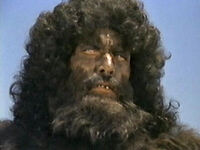
The film examines life on the margins of the medicalized landscape of America. Human guinea pigs, army medics with PTSD, an anarchist labor organizer on Adderall, a drug detail man turned medical anthropologist studying the effects of Paxil on chimps at the Milwaukee zoo, train-hopping newlyweds on a litany of test medications, and a woman who lives in the back of a Bigfoot museum on 20 separate meds for bipolar schizophrenia are some of the subjects covered in the film. So I guess at the very least, Bigfoot is in it.
E: Doctors and drugs and bad guys. I get it. Now, does my name appear in the credits?
MP/DM: No, it doesn't. Actually, we took a closer look at your website and it seems that you actually know Carl, but I get the feeling you don't like him very much. Did you know we were heavily inspired by his work in the making of this film? Is that a problem?
E: "His" work? That's what he told you? Nothing to do with me? Actually, no, it's not a problem. I've moved on.
So, just for the sake of argument, what part of "Carl's" work was it that supposedly inspired you? Was it "his" philosophical ideas? Or was it his more recently acquired, nearly sociopathic resentment of the pharmaceutical industry and anyone who works for a living? Or could it have been his knack for stealing other people's ideas and making money off them? Does plagiarism inspire you?
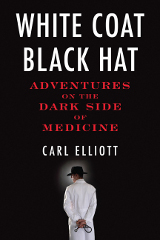
MP/DM: I hardly consider Carl's work "plagiarism", nor our interest in expanding upon the subject in his article through a documentary film, but given your tone, it seems like anything's game. "Better Than Well" was a huge inspiration on the film, as well as "White Coat, Black Hat", the book you're promoting on your site that you seem to love so much. But Carl's article in the New Yorker, "Guinea-Pigging" was a sort of launching-off point for us and began us down a long and winding path examining medicine on the margins. A character in the film, Robert Helms, is actually in that article.
Say, I notice you designed the whitecoatblackhat.com web page in the Vegur font, one of those go-to fonts everyone seems to be using these days. Did you know it's a blatant ripoff of the Myriad font? And lemme guess, you're probably using the Word-Press template for the site. How… original.
E: Oh, right, that's it! I forgot to invent a new font for the website! Hey, I bet that's why Carl hates me. It's because I've been sticking with standard-issue fonts. That must be such a drag for him after paying -- how much for his website again? -- oh, yeah. NOTHING. Whatever.
But enough about me. I notice the two of you collaborated on this Bigfoot movie of yours, and that you've also done a couple of projects together in the past. Yet interestingly, I'm only hearing from one of you (Michael). My question is: Does either one of you ever feel the urge to hog all the glory, or maybe steal the other person's ideas? For example, have you ever collaborated with one another via email for months on end, only to see the other person run off with a script, make a pile of money and give you no credit? Then, maybe coming back later, saying something like, "hey, buddy, how about taking a volunteer job as key grip? It doesn't pay shit, but it could be your big chance!" Anything like that?
MP/DM: "We" collaborate together on all of our documentary work, it started with "October Country", a doc that came out in 2009 that also features witches, ghosts and gun factories, in addition to the social ills that plague the working poor in Central New York. Sadly Bigfoot didn't make it into that film, he ended up on the cutting room floor after a long argument about the direction of the content of that film. But "we" enjoy working with one another because we come at things from different perspectives, often fighting for weeks on end over an edit only to find out the compromise we reach is almost always better than our individual take on things. Donal's background was as photographer and writer first and foremost, and I've been a filmmaker and spotlight-craving whore my whole life, so that's probably why I chose to write back to you first. Just think of me as the documentary version of Sally Field accepting her Academy Award in this clip at the 3:20 mark. Donal cares less for these non-productive interviews, he has busy photo career, sort of like Faye Dunaway in The Eyes of Laura Mars.
But just because our responses are coming from my email address doesn't mean we aren't both poring over your questions/attacks at length. Suffice it to say Donal finds your tone really acerbic, and he seriously questions your intentions at all in interviewing us. He did notice that you ducked our inquiry on the all-too-overused word-press template design for whitecoatblackhat.com. Don't think WE aren't both waiting to hear back about that.
E: We're back to that WordPress template again? OK, once more, with feeling: I don't get paid for this shit. Sometimes, those of us in the creative professions are asked to create something out of nothing. Some people buckle under the challenge, but the more visionary types will take ordinary, freely available materials from our everyday life and impart new meaning to them. To wit: My brother bullies me into setting up a promotional website for a budget of jack shit. I then take an ordinary, colorless WordPress theme and transform it into a viral sensation, the bioethics world's most successful blog. That's what other people call resourcefulness. Innovation. Thinking outside the box. Not that I really expect you to understand my process, but let's just say I can't just cut to a car chase or throw in some fancy CGI whenever things get boring.
Now, if YOU're done interviewing ME: I think my readers will want to know about your Bigfoot movie. Why Bigfoot, and why now? Are you doing voiceover narration like Leonard Nimoy , or acting it out like Andre the Giant did? And why the medication angle? Was it Carl's idea to medicate Bigfoot? Because it doesn't sound ethical to me.
MP/DM: Car chases? Fancy CGI? We make documentaries on shoestring budgets, so we also have to be resourceful in our creative strategies. In fact, we have a Bigfoot re-enactment in this film but we couldn't get Andre the Giant to play Bigfoot, so we did it from Bigfoot's POV instead. No one can replace Andre, and Bigfoot deserved the best to bear his likeness, so we came up with that solution. Ultimately our credibility as filmmakers rests on the effectiveness of such re-enactments so we had to tread carefully down that road. But it is really insightful that you mentioned the Andre the Giant clip from the Six Million Dollar Man. The subtle use of slow-motion and sound effects was way before its time. These kinds of artistic strategies are instrumental for us in our work to draw an audience in with the limited material we gather in the field. See, Ethicator, it seems like we have more in common than I actually thought. We're both resourceful. I can't ask Donal whether he likes this Steve Austin reference or not because he's off photographing the working class for a hard-hitting story about those who can't afford designer jeans, but he said he'd be back in a few minutes.
As for the medication angle, the whole film was actually proposed to us by our producers, Anish Savjani and Vincent Savino of filmscience. (filmscience.com) They became interested in a story about human guinea pigs by Josh McHugh in Wired Magazine called "Drug Test Cowboys", as well as the article that Carl wrote for the New Yorker. We ended up reaching out to Carl and he kindly met up with us in Minneapolis. We kind of hit it off instantly, and spent numerous hours at The Bad Waitress discussing the possibilities of shaping a different kind of film about health care where everyone is implicated - not just the drug companies, but drug sales agents, doctors, and especially patients. The problem of overmedication is systemic; we don't aim to say all that drugs are bad, because we need medicine, but there are certain aspects of the drug industry that are dubious, where ideas and actions collide in complex and associative ways that a consumer may not necessarily be aware of. We think that's worth exploring in a film. We'd even go so far as to say it's the ethical thing to do.
E: OK, I think I'm understanding now. You made a Bigfoot movie, but couldn't do any CGI or car scenes, so you just got a tall guy to walk around with a camera. Fine. But out of respect, could you at least call him a Sasquatch? Bigfoot is the racist term, and it's making me uncomfortable.
Also, like Carl, you think people take too many pharmaceuticals. Is that why you're medicating a Sasquatch instead? What kinds of drugs did you test, and did Carl design the research protocol? As an ethicist, I find that deeply troubling. I could really nail Carl over that one.
MP/DM: Wait, what? We weren't testing any drugs, and we weren't medicating Sasquatch either. We made a film about people who are implicated by the pharmaceutical industry in numerous ways. Carl didn't have anything to do with testing anything! What's your beef with this guy?
E: OK, so now you're confusing me. First you're telling me about a racist, drug-addled Sasquatch movie, and now it's just a movie about doctors and drugs and bad guys. It all sounds hard to follow. No offense, but I think you need to work on this interviewing thing. Focus your message, is all I'm saying. Just some friendly advice.
That said, have you ever thought about making a movie about a Sasquatch on psychoactive drugs? Maybe with social anxiety meds? If you do make this movie, I would expect you to put my name in the credits like you did for Carl.
MP/DM: We'd very much like to make that film. Do you have any thoughts on how we could convince Bigfoot to try Risperdal?
E: Again, Sasquatch. Bigfoot is the racist term.
I am not sure about administration, but in my professional opinion, an anti-psychotic would likely make the Sasquatch more docile and less socially phobic. Also, unfortunately, less skilled at karate.
Still, let's not put the cart before the horse. There's a lot of legwork to do. For a project like this, you'll need a media-savvy bioethics geek, somebody who can navigate the waters between Big Pharma and Big Ethics. Just blue-sky thinking here, but I believe we'll need to fire up a mission statement, bang out some research protocols, get an IRB, the works. As a crossover type, I think I could work that out for you, but we'll need some face time to iron out the numbers.
MP/DM: Sounds like you're gonna get a producer credit for sure.
E: Thank you. Carl can be the key grip, if he'll work for free.
The Ethicator: Do you have a conflict of interest?
Dear Ethicator:
I have been reading your blog, and although you seem to be an eminent bioethicist, I am troubled by your scholarship. You seem to hold a grudge against your brother, which seems to make you oppose everything he says and attack him every chance you get. Are you really able to do your job properly, or is there a permanent conflict of interest at work here?
Signed,
Concerned
Dear concerned,
You are committing a fatal, disabling logical fallacy by conflating two distinct and separate roles I occupy: First, my role as an internationally recognized bioethicist and viral sensation, and second, my role as a younger brother to a bigshot bioethicist asshole. The two roles are distinct. By conflating them, you show a serious failure in the most basic principles of scholarly integrity, principles which have been with us since the time of Socrates. Indeed, if you were a student of mine, I would flunk you for the semester, demand your expulsion and perhaps recommend your involuntary commitment to an institution. The burden of proof is on you, not me, to demonstrate that I am not discharging my duties according to the requirements of the field. Otherwise, through your reckless accusations and serial failure in scholarship, you tarnish the field of bioethics, which you are not free to do. You are obligated to withdraw your comments immediately, cry “uncle”, and declare your public admiration for my work.
Sincerely,
The Ethicator
Dear Ethicator: How do I get out of here?
Dear Ethicator,
A while back I got a spam email inviting me to be on the editorial board of a new journal. I had never heard of it, but I was coming up for tenure, so I said yes and added it to my CV.
Last week, I finally got around to checking the Internet and found your "journal." Is this some kind of joke? You said the journal was peer-reviewed and had the highest impact factor in its class. But as far as I can tell, you spend all your time insulting your brother. Am I supposed to have heard of this guy? You give out terrible advice, and you whore yourself to private industry at every opportunity. I am a strong advocate of civil discourse, and I am embarrassed to be associated with this. Plus, I have tenure now. So my question is: how do I get off?
Sincerely,
Regretful
Dear Regretful,
I'm sorry. I missed the part where you thanked me for saving your academic career. I'm sure you intended to start with that, because that's the only thing any decent person could say under these circumstances. Your name is now associated with one of the three most widely cited websites in the history of the bioethics field. You have a lifetime meal ticket that can't be revoked, as long as nobody catches you in the faculty lounge with your pants around your ankles. That's my gift to you. You're welcome; use it well.
How do you get on my editorial board? It's easy: Say yes, give me your name, and – this is the hard part – shut the fuck up. Seriously, put a sock in it. Stay quiet, no matter what I say or do. Remember: this job is about loyalty, nothing more. It may seem unsettling at times -- in fact, there will be days when you wonder if I am a batshit crazy, self-destructive psychopath -- but you've got to remember there's a method to my madness, and if you stick with me, you'll go places.
You want out now? Look: What you don't realize is that you've already boarded this crazy train whether you like it or not. I've been writing this shit for a year and a half -- where've you been? Sorry, too late. Your best hope at this point is to stick it out with the man who got you here. And in case you didn't notice, I blog and tweet like a motherfucker. You want to cut me loose in public, hoss, go right ahead.
Your loving mentor,
The Ethicator
My Open Letter to the Chronicle
To the Editors of the Chronicle of Higher Education:
In his March 1 blog post on your web site, Carl Elliott makes a number of defamatory comments about “Internet trolls” who harass him online and are “occasionally funny.” Although he does not mention my name, it is clear to everyone that he is referring to me. This characterization is malicious and false.
According to Google’s accepted definition, trolls are “mythical, cave-dwelling beings depicted in folklore as either a giant or a dwarf, typically having a very ugly appearance.” Fact: I am not a troll. I am a real person, a conventionally handsome, middle-aged man of medium height and build – a far sight from being a troll. I live in a house, not in a cave, or under a bridge. That is a matter of public record, and Carl Elliott knows this. Any attempt characterize me as a troll is demonstrably false, malicious, and by definition, defamatory.
Equally false and malicious is the characterization of me as “occasionally funny.” Fact: Among bioethicists today, I am widely recognized as one of the five funniest commentators on the Internet. As such, I am more than occasionally funny. This is easily measured, and again a matter of public record -- but again, Carl has simply chosen to ignore the facts.
Finally, Carl Elliott has failed to disclose a Conflict of Interest (COI). Fact: For the past year and a half, I have been operating the White Coat, Black Hat website, where I routinely ridicule him for stealing my ideas, failing to pay for his website, and being a bad older brother. I have photoshopped his picture several times, once to look like a werewolf and another time to look like Nixon. The characterizations obviously left him embittered, vindictive, and humorless -- Certainly in no position to render judgement on my physical appearance or my sense of humor.
I expect the post to be removed by COB Sunday, March 4, or I will take the appropriate action.
Yours sincerely,
The Ethicator
PS Carl: You've been served, fucker.
The Ethicator: How much money should I take from Biotech?
Dear Ethicator,
You are my personal hero and role model. Just thought I'd get that out there right at the start, just in case it might influence your answer.
I am writing you because I have a problem. Like you, I am a world-renowned bioethicist and digital pioneer. Recently, I was asked to perform an ethics review of a highly reputable, scientifically driven, offshore stem cell clinic. There's only one problem. A few people have died after getting the injections. Not that it's their fault or anything; these things happen. In fact, I suspect this clinic might hire me full-time at some point in the future. My question: when I clear them of wrongdoing, would it be impolite to ask for an "honorarium"? How much do you think would be appropriate?
Your Willing Disciple
Dear Willing Disciple,
No, sir, you are the hero. You have taken leave from your cushy, well-paid university job to make a difference in the world. While the rest of us sit and pontificate, you are out there getting your hands dirty, 24/7, keeping the life-saving innovators on the up-and-up. Sure, some jealous colleagues will raise an eyebrow or two, but remember: You are one of the good guys. Otherwise, nobody would have given you the title.
Should you get an honorarium? That is a tricky question, one that requires a bit of fact-finding, consultation and a thorough study. You need an independent investigator, someone outside of both Big Ethics and Big Industry, an established ethicist who is not corrupted by the prejudices and petty jealousies of the university scene. Until very recently, there were no such people in the field, but thanks to some of my own pioneering work on the Internet, a number of new possibilities have opened up. For more details, feel free to contact me individually.
With good wishes,
The Ethicator
Some doodles
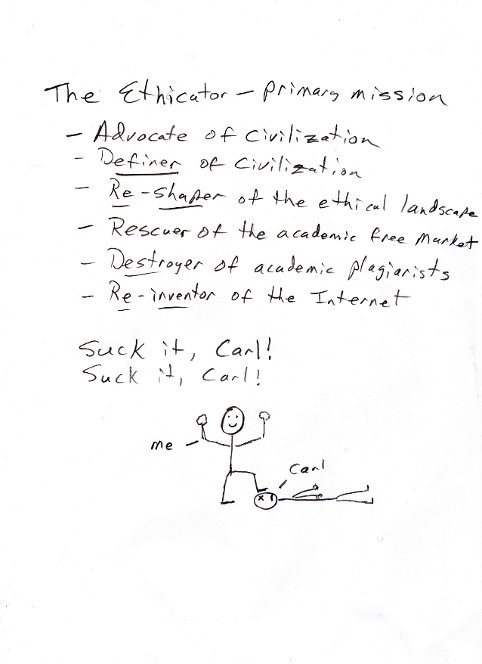
Just some random doodles I did in my spare time. I do that kind of thing. I hear a lot of leaders do.
The Ethicator Interview: Misha Angrist
Note: This is the first of what I expect to become a series of interviews with various writers and academics seeking to utilize my fame. If you are important and would like to be interviewed by the Ethicator, feel free to send me an email.
Misha Angrist interviewed Carl a couple of weeks ago. In the interview, Carl called me "disturbed" and ridiculed my groundbreaking academic writing as "hilarious." Courageously, Angrist agreed to make amends by facing me for an interview. We communicated by email.
E: Thank you for facing the Ethicator. First question: Please state your name, profession, and the book you are attempting to sell us.
MA: Hi, Ethicator. My name is Misha Angrist. I am an Assistant Professor in the Duke University Institute for Genome Sciences & Policy. My book is called Here is a Human Being: At the Dawn of Personal Genomics.
E: Interesting. And you wrote this book yourself? I'm just asking because, you know, there are some academics out there who can be cavalier about this sort of thing (authorship), if you get my drift . . .
MA: I'm not sure I follow you. Anyway, yes I wrote it myself, although I couldn't have done it without the generosity and talent of a lot of other people. And by the way, your brother's terrific article, " Guinea-Pigging," is mentioned in the book.
E: You mean the New Yorker article allegedly written by my brother? Right, I know all about that. A lot of familiar stuff there. Reminds me a lot of these "jobs" he kept enrolling me in at the U, back when we were living in Chicago. ("Hyde Park rent is expensive, you know." "It won't hurt," "I'm just a post-doc, I don't make that much - Gotta pull your weight!" and so on). Strangely, my name does not appear in the article at all. Anyway, water under the bridge.
Your book is on genetics. I've heard it said there is a genetic basis for cruelty and bullying behaviors, such as those we often encounter with siblings. Is this true, and what are your thoughts about this?
MA: Aggressive behavior in humans almost certainly has some hereditary basis, but it's not clear how important genes are in these types of traits. They are terribly hard to study and in most cases whatever genes are involved are probably interacting in ways we don't understand yet. It's a tough nut to crack. My colleagues Terrie Moffitt and Avshalom Caspi are among those who've been trying to unravel this stuff for a long time...I love them and admire their intelligence and doggedness, but I worry about them.
I should say that there's also a pretty strong evolutionary argument to be made for niceness. In any case, I think most geneticists expect most of these sorts of behaviors to be the product of the action of many genes plus a huge environmental component.
E: Well, that's where you're wrong. I hadn't given this matter any thought until just now, but my brother and I obviously share some genetic material. He is an overly aggressive, bullying pharmascold with no moral compass whatsoever -- damn near a full-on psychopath, according to many in the field. Yet, I share none of these repulsive traits. How can that be? So I disagree with you that it has a hereditary basis.
But OK, for the sake of argument, I'll play along. I understand you had your own personal genome mapped. Do you carry any of those bullying genes you apparently believe in?
MA: I don't think so. That said, my brother would say that I do, just as you do about your brother.
I can't claim to know your brother very well, but I will say that he is deeply concerned about you. He thinks you need to be on medication.
E: Yeah, I read that quote in your interview. Yes, Carl is concerned: Concerned that one of these days, I'm going to show up at his house with an invoice for all the work I've been doing. He'll be all, "Oh, no! Where's Nurse Ratched? My brother won't do shit for free!"
But enough about me. You're in the genetics game, right? There's big money in that, I hear. Have you found a good corporate sponsor?
MA: Not yet, though not for lack of trying. Unfortunately most of the small startups I take an interest in end up in Chapter 11. But since a WalMart VP suggested a few years ago that the company try to avoid hiring fat people in order to reduce its health care costs, I was thinking they might be able to use my services in Bentonville.
E: Wal-Mart! That shows some pretty impressive, out-of-the-box thinking on your part. Yet, I suspect there are some dinosaurs out there in the bioethics industrial complex who would love to ruin your plans. Seriously, though, isn't it hard for an independent-minded visionary like you to get by without eventually giving in to pious, overweening pharmascolds? How do you do it?
MA: Dude, you're breaking my heart. Was there something that went awry in your childhood that led you to have such contempt for your brother? Is there no way to heal this rift? I mean, the Everly Brothers got back together. Will the Elliott brothers not share Christmas together?
E: Hey, water under the bridge. Unlike some people, I've moved on. When you speak hard truths to stubborn people, as I do, you just have to expect some resentments and petty jealousy to come back your way. It's just the nature of the game.
Speaking of bold truth-telling: Have you been following my website and twitter feed? What do you think of it?
MA: I do look at your website. The production values are high and the graphics impressive. That said, I might argue that it's hard to read that and your twitter feed and then conclude that you've "moved on."
E: Do I remind you of Steve Jobs?
MA: Um...I don't know. The turtleneck and the petulance maybe?
BE: Well, I'm just thinking of the effusive praise you had for the user interface on my website, plus the runaway viral success of my work thus far. And of course the fact that Jobs and I are both considered renegades and trailblazers. I sometimes think of myself as the Steve Jobs of bioethics. Not that I would put words in your mouth or anything.
MA: Well, I guess if the shoe fits, right? But I imagine that that's quite a heavy burden, no?
BE: Yes, a heavy burden indeed -- but not as heavy as Carl's burden, which is being known only as the brother of the Steve Jobs of bioethics. I'm sure he can manage that, though.
On to your book. What is it about -- genetics or something? I forget
MA: Yes, my book is about genetics or something. More important, it is about ME. And even more important than that, it is available in hardback, paperback, e-book and large-print-Sanskrit formats. And it makes a swell gift for any occasion! And since it's published by HarperCollins, you can rest assured that most of the money from every copy sold will go directly into the Rupert Murdoch Defense Fund.
E: Sounds interesting. If the library has copies on the shelf, maybe I'll look at it. Thank you for your kind, effusive praise of my work, and congratulations on being the first interview on the most popular site in bioethics.
MA: I trust that you and Carl will bury the hatchet--it's the bioethical thing to do, after all. Thanks so much for having me on The Ethicator! It's been a dubious honor!
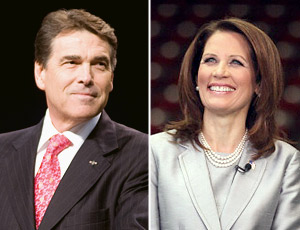
The Ethicator’s Moral Hero of the Week: Rick Perry
At last night's Republican Tea Party debate on CNN, things got a little testy over Governor Rick Perry's executive order mandating HPV vaccinations for 11- and 12-year old girls. Michele Bachmann accused Perry of a conflict of interest with Merck pharmaceuticals, but Perry knew just how to brush it all aside:
“It was a $5,000 contribution that I had received from them. I raise about $30 million. And if you’re saying that I can be bought for $5,000, I’m offended.”
Amen to that. Perry practically gave it away. Next time, Merck, if you want to mandate a vaccine, you better be prepared hand out some major scratch.
Got a moral issue you just can't solve? Send your questions to the Ethicator: info@whitecoatblackhat.com
Heroes at Globe and Mail Boldly Praise Ghostwriting
Check out yesterday's copy of the Toronto Globe and Mail, where the heroes in the editorial section take a bold stance in favor of pharmaceutical companies hiring ghostwriters to publish in peer-reviewed academic publications. I say good for them.
Now, I know what you are all thinking: As a victim of ghostwriting myself, shouldn't I be against the idea? Well, not exactly. If you pay your ghostwriters (unlike someone else I know), I'm all for it.
Let's face it: Scientists have the credentials and the name recognition, but can they make their product sound awesome? Not a chance. Bad self-presentation is an occupational hazard; just look at the way they dress. Plus they're busy.
And yes, as the Globe admits, there is a danger that these Big Bad Pharma Companies will turn the articles into an advertising opportunities, but hey, that's the reviewers' job to sort out. Which is why the Globe calls for "particularly vigilant reading of the draft by the researchers, so that no advertising spin creeps in". Caveat emptor, baby -- we've got bigger fish to fry. Kudos, G&M.
The Ethicator
Got a moral quandary you just can't solve? Send your questions to the Ethicator: info@whitecoatblackhat.com
An important announcement about the PharmaVoice 100
I apologize for not posting sooner. This morning, as you all know, PharmaVoice released its list of the 100 most inspiring people in the life sciences. Mysteriously, and despite the massive groundswell of grassroots support I received, my name was not included on this year's list.
No doubt many of you will see in this the hand of a jealous sibling, or the petty vindictiveness of a powerful, pharma-bashing NGO. Of course, it's not for me to say whether that assessment is bang-on, or whether it confirms what we really all should have known from the beginning.
What I can do is thank you all for your support, congratulate this year's winners, and appeal for calm amidst your crushing disappointment. I know you are all angry right now, but please, keep your demonstrations respectful and nonviolent. We are not like them. Remember the words of Jesus: What does not kill us, only makes us stronger.
I will be fine. There are more accolades to garner, more contest forms to fill out, more battles to win. Soldier on, my friends; you are all heroes, each and every day of your lives.
The Ethicator
Got a moral issue you just can't solve? Send your questions to the Ethicator: info@whitecoatblackhat.com
Building Your Brand the Ethicator Way
A recent article in Inside Higher Ed offers some handy advice on how to build and enhance your academic brand. Titled "The Value of Self-Promotion", the article has generated some controversy by suggesting that new academics should cite their colleagues' work for professional gain:
You should be citing all of the senior people in your field, even if their work is tangential to your own. Citation is a way of demonstrating that you know your field and you know who the key thinkers are. It is amazing how often the same person will be asked to referee your work.
Now, I can’t say I’ve spent a lot of time advancing myself in academic circles (unlike one bootlicking, sycophantic assclown whose book you may remember); however, as an Internet-based bioethics expert, I'll say this sounds about right. What's academic publishing for, anyway, if not for advancing your career? Do it right, I say.
But there's also another side of me, the Internet marketing expert, that asks the obvious questions: Citations? Peer-reviewed journals? Does anybody read these anymore, let alone write for them? Seriously, what decade is this?
Listen to me: If you want some bang for your buck, take to the Internet. And don't just cite your colleagues; any milquetoast can make nicey-nice with the boss-man. You need to find out who your colleagues' enemies are, then start firing away in the online forums. Take to the comments section of the newspapers and the online media (hell, take two or three screen names if you want, and trade insults off one another). Rack up 2500 Facebook friends, including your senior colleagues, and start wailing away at the bad guys. All this you can do in a third of the time it takes you to write a paper proposal, yet you will reach thousands more people and leave a permanent, lasting impression on the people you want most to impress. It's quick, it's cheap and it's unfiltered: That's the Ethicator way.
Got a moral issue you just can't solve? Send your questions to the Ethicator: info@whitecoatblackhat.com
The Ethicator – Swept Up in Another Grassroots Movement

It seems your generosity has no limits. A mere month after nominating your humble servant for the PharmaVoice 100, another mass, grassroots movement is under way. This time, the prize is the Dorland Health People Awards, which as it turns out, has an ethicist category. As the Editor in Chief herself has said:
Ethicists are an integral part of the healthcare field, making a profound difference and positively affecting individuals and improving quality of life across America. It takes an exceptional person to do what you do, as I can attest to from my years of clinical healthcare experience.
So there you have it. The only barrier is the $290 admission fee, but since there are hundreds of you out there, the cost per person should be peanuts.
No doubt, Carl Elliott and his raging band of anti-pharma thugs will try to scuttle this, just as he has always tried to squash my academic freedom at every turn; but this is your chance to beat the odds, fight back, and score that rare victory for Freedom.
The application deadline is this Friday, June 10. You can get the details here.
My name: The Ethicator
My organization: White Coat, Black Hat website
My title: CEO and Proprietor (pro-bono)
You are all heroes. Thank you.
Got a moral issue you just can't solve? Send your questions to the Ethicator: info@whitecoatblackhat.com
The Ethicator: Did I vote for the right person?

Dear Ethicator,
I recently encountered a problem with coercion.
Someone I know of from the ethics world tried to manipulate people into nominating him for an honor. It seems that this person is trying to make his mark in the ethics world and does blatant self-promotion, sometimes at the expense of others. He decided that he should be nominated for an award given by a prestigious group from Big Pharma. He embarked on a campaign of wheedling, flattery and pleading to try to manipulate his readers into nominating him for this award. I and others were besieged by e-mails. All the same, begging to be nominated. Some of the e-mails were sent in the early hours of the morning. Not only was he obsessed with this idea, he was trying to drive us crazy, apparently hoping that his barrage tactics would force up to nominate him.
I was torn. This ethics geek seems to be dedicated, though sometimes his opinions are skewed. I really wanted to nominate someone who would merit the honor, like the world famous Carl Elliott. Or even the unemployed Randy Cohen. But, in the end, I caved in and nominated the dweeb. I was just too worn out by the endless e-mails.
Did I do the right thing?
Thanks.
MT
Dear MT,
I can see why you were torn. A bold, fresh face bursts onto the ethics scene, skyrockets to fame, and forces you to confront your conscience. You think to yourself: Shouldn't such courage and grace be rewarded in some way? Who else is more deserving? And seriously, isn't filling out that little nomination form the least you can do?
Still, you realize your move will be controversial. There are so many safer nominees out there: People who have been flaunting themselves in the media for years, people who would no doubt want to bully you into nominating them instead. In fact, who knows what the consequences will be for you, once this self-promoting narcissist learns you've passed him over for a more deserving candidate? You face all these questions and still, you vote your conscience. Good for you.
You did the right thing. Sleep well.
The Ethicator
Got a moral question you just can't solve? Send it to the Ethicator: info@whitecoatblackhat.com
The Ethicator: It’s not Personal, is it?
I am thinking about jumping on the bandwagon and nominating you for the PharmaVoice 100. With the deadline (May 1) fast approaching, I must confess that I still have some reservations about you as a candidate. Don't get me wrong: I think you're brilliant and all, but at times, your attacks on your brother seem, well, a little personal. Is it really ethical for you to set up a website attacking your brother on a daily basis? Help me out here.
Sincerely,
Queasy
Dear Queasy,
I am deeply dismayed that you would threaten my academic freedom by posing a question like this. As most of my readers know, the White Coat, Black Hat website is not meant as an indictment of any particular individual. Instead, it's intended as a forum attempt to address, as a matter of policy, the problem of cheapskate fuckers who steal their brother's ideas and turn them into hate-speech infested polemics against hardworking pharma patriots.
The issue raises lot of questions that merit further study. For example: Is it appropriate for a so-called bioethicist to exploit his brother's goodwill and force him to work for free? Are others in the field obliged to speak out in defense of the victimized younger brother? I'm just putting the question out there; nothing personal. Also, if the brother decides to go online with his concerns and suddenly becomes an online viral sensation, well, what then? Is the plagiarizing fucker expected to take it like a grown-up, or is he entitled to whine like a baby and maybe sue? It's a question of professionalism and academic integrity, for which some high-level discussions may be necessary.
I hope this clears matters up for you. Remember: 5 more days until the PharmaVoice 100 deadline!
The Ethicator
Got a moral question you just can't solve? Send it to the Ethicator: info@whitecoatblackhat.com
The Ethicator for the PharmaVoice 100? You are too kind.
I have just gotten word that there is a movement afoot among you, my loyal following, to nominate a certain columnist to the PharmaVoice 100, PharmaVoice magazine's annual list of the 100 most inspiring pharmaceutical industry leaders. I am deeply, deeply humbled.
Now, there is something you must understand about my work as a bioethicist. It's not about the awards, not about the fame; it never was. It's about justice, it's about service. It's about speaking truth to power, and maximizing your ROI in the process. It's about being that lonely voice in the wilderness, a piercing laser of Truth trained squarely on the cornea of humanity: Standing, like Patrick Henry at the barricades of Fort Sumter, shouting "Here I stand; I can do no other!"
Also, it is about bringing down that piece of shit book my brother Carl wrote.
So really, I don't know if I deserve this award, but far be it from me to stand in the way of a spontaneous grassroots movement. You can find the application form, as well as the nomination criteria, on the PharmaVoice website. The deadline for nominations is midnight, May 1. Also, in case you need it:
My name: The Ethicator
My organization: White Coat, Black Hat website
My title: CEO and Proprietor (pro-bono)
God bless you all.
The Ethicator
The Ethicator: Am I Selling Students a Bill of Goods?
Dear Mr. The Ethicator,
I'm a graduate student at a large public research university that is facing severe budget cuts. While our TA-ships and other teaching gigs could never have been considered plum jobs, these days the university is thinking ever more creatively about new ways to squeeze extra work out of us. And not only this: the fate of our graduate program and our department is very much up in the air, as the university looks for ways to cut costs by closing programs and merging departments. No one knows exactly what's coming, but it doesn't look pretty.
The ethically murky area is this: every year, we recruit a group of new graduate students, flying them in from all around the country, and everyone pitches in to try to convince them to join our department. We did this again this year, but without exactly playing up (or mentioning) the real uncertainty about the future of the institution. Did we sell them a bill of goods? Either way, we knew it would hurt the department not to admit grad students for the coming year. In fact, if none of them were to join the department, it would likely be even easier for the university to shut us down.
Yours,
Reluctant Pitchman
Dear Reluctant Pitchman,
I'm sorry. I'm having trouble getting past the part of letter where you tell me your department brings in a whole load of young, healthy research subjects every year, and all you do with them is make them grade papers. Are you serious? What kind of business model is this?
I know you academics aren't known for your business smarts, but seriously, do you realize how much bigger your ROI would be if you hooked up with a drug study? Better yet, find somebody testing an ADHD drug. That way, you'll get pocket money, party medicine, AND some super-efficient graders who never get bored. That, my friend, is what we call a win-win.
Look: I can tell you're one of the good guys, just doing your best to look out for the peeps. Good for you. But remember what the airlines say: When that oxygen mask drops, you put it on yourself first. Then you help the next guy. Or, maybe you don't, because there's only so much oxygen on the plane and the other guy would probably hog it. But anyway, the point is, you have to look after yourself. Keep bringing them in, keep them working, and sleep well.
You're welcome,
The Ethicator
Got a moral question you just can't solve? Send it to the Ethicator: info@whitecoatblackhat.com
Speak Truth to Power: Join the Social Media Revolution
"For the last shall be first and the first shall be last"
Bob Dylan and Jesus could hardly have forseen the truth of these words. Social media is now the Gutenberg press of early 21st-century brand management. From the twitter revolutions in Tunisia and Egypt to my own efforts to bring down lying cheapskate plagiarists, social media has become the great, revolutionary, rectifying force for humanity.
That is why you need to "like" my facebook page, and start following me on twitter (@whitecoatblackh), right away. If you are only checking my blog 4-5 times a day, you are missing out, big time. Worse, if you are not following social media, it's highly likely that your friends and colleagues are already starting to think of you as old and out of touch. Pretty soon, they will stop taking you seriously at all.
Don't let this happen. Be a part of the revolution.
Be the change you want to see in the world.
Be One of Us.
My twitter feed is @whitecoatblackh. The Facebook page is here.
The Ethicator: Should I “campaign” for an award?
I am an ethics graduate student myself, but find to be stuck in a sticky ethical situation. I am currently a Teacher's Assistant (TA) for an upper level undergraduate course. The semester is almost over, and the department I am working for is offering a TA award. The way it works is to have students nominate you, and get the professors to co-nominate. From what I can tell, the profs I am TAing for would have no problem co-nominating me, however it must be the students who initiate it.
I would greatly appreciate getting this award, not only because there is a monetary and certificate component, but also I believe Idid a grea t job at TAing this semester. I spent more hours than allocated meeting with students, giving thorough feedback on midterm reviews, and guidance throughout the whole semester regarding presentations and the final paper (on top of all this, I myself am a full time student with a heavy course load!)
The profs have announced the award through the online course system, though I don't know how often students actually check it. It's also a bit of a runaround and somewhat inconvenient: printing, filling out, signing, scanning, emailing/faxing...
Because of this, I feel the need to remind the students, yet I find myself torn as to whether I should make an announcement on the last day of class or via email asking to be nominated- what do you think? How should I go about this? Does this sound like I am campaigning myself? My internal 'yuck' factor is kicking in - but I am concerned if I don't remind or persist for it by the students, I may not luck out. How do I work the system ethically?
Thoughts?
Ethically Perturbed TA.
Dear Ethically Perturbed TA,
Yuck factor? Walk it off. This is just the first of many compromises you'll make in the ethics racket. This job ain't for sissies.
Here's what you should tell your students: The nomination process is difficult and lengthy, but it's a small price to pay for what they are likely to receive for nominating you. The payoffs for them could be material, such as free drinks or prescription meds; or they could be something less tangible, such as the knowledge that you will be in a much better state of mind when you grade their final papers .
Unseemly? Not at all. Remember: You are not bribing; you are incentivizing.
Also, one final word: You have competitors for this award, and they'll need to be dealt with. I`ll leave the details to you.
Keep building your brand,
The Ethicator
The Ethicator on the Ethicist: Should I really write my own recommendation?
Dear Ethicator,
Your inferior counterpart at the New York Times recently told a reader that it was perfectly ok for her to write his or her own letter of recommendation for law school and then have a former professor sign it. I'm thinking of doing this myself, but still, I'm not sure what I think of her advice. Does it sound fishy to you?
By the way, I'm disappointed Ariel Kaminer was chosen for that job; it should have been you.
Sincerely,
Need a Second Opinion
Dear Second Opinion,
Whoa! Not so fast there. I have no beef with Ariel Kaminer; we're both professionals, both trying to make the world a better place. Unlike other ethicists you might know, I do not get my kicks running down my colleagues in the profession (or stealing their ideas, or exploiting their labor, for example).
And besides, she is right. If you think about it, this is all about building your brand with your target audience. And who is better positioned to do this than you? Face it, your supervisor is dead weight; most academics wouldn't know a good sales pitch if it bit them on the ass. Write that recommendation yourself, and you'll know you've struck the right tone. And remember: it's not lying if you really believe it. If you can honestly say you are on your way to a Nobel Prize, feel free to point that out.
Job recommendations are just one of several kinds of notes you're better off writing yourself, and letting someone else sign. Some other examples I'd recommend include:
- Award nominations
- Promotion letters
- Book reviews
- Medical prescriptions
Uncomfortable? Sure. But unethical? No way. Now go get 'em. You're welcome.
The Ethicator
Send your questions to the Ethicator: info@whitecoatblackhat.com